
Patrick Strait has authored a book on the History of Acme Comedy Company in Minneapolis: Home Club: Up-and-Comers and Comebacks at Acme Comedy Company.
Because I’ve played there more than any other comedian over the past 33 years, I was obviously a big part of that History.
Courtesy of the author I’ve been allowed to post an excerpt of the book, Chapter 6, which summarizes some of the antics in which I’ve engaged at the club during those three decades.
If you enjoy this chapter, you should see the entire book!
Chapter Six
Tim Slagle knew early on that he and Louis Lee were going to be friends. He also knew that not everyone appreciated his politics. “I started working at Acme because Becky [ Johnson] thought I was cute,” Slagle laughs. “The Hansens didn’t find me funny, but Acme did, so I started coming twice a year.” A Chicago-based comedian whom the Star Tribune once, early on in his career, called “a Libertarian Lenny Bruce,” Slagle loved to push the audience. Whether that meant challenging people’s political beliefs, bucking gender norms, or taking the contradictory stance on, well, pretty much anything liberals were on board with, Slagle’s comedy was just as polarizing as it was funny.
Acme had been around for only a year when Slagle first arrived on the scene, but he felt comfortable there, even with his unique brand of comedy. “I found a home,” he continues. “The Acme crowd was so nice that even if they didn’t find you funny, they’d make you feel welcome.” That welcoming attitude was put to the test one night when Johnson raised a concern with Lee over one of Slagle’s jokes. “Becky loved my act until I started doing a bit about guys named Richard who will call themselves Dick, but women named Constance will never shorten their names beyond Connie,” he recalls with a laugh. “She went and told Louis that she couldn’t book me anymore.
• 75 •
76 • CHAPTER 6
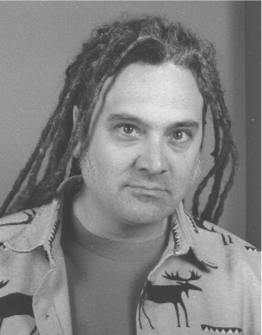
Yes, that’s his real hair. A dreadlocked Tim Slagle in his early Acme days. Courtesy Jen Bryce
He said he wanted to see the bit, so he came out of the back for the next show and watched me. He said there was nothing wrong with the bit, and I’ve been coming back every year for over thirty years.”
Lee himself identifies as a political conservative, though he maintains that his personal beliefs have never influenced who he would or wouldn’t allow to perform at his club. Other political comics, from Bobcat Goldthwait to Wyatt Cenac, have also found a platform at Acme to share their opinions, but no one has done it quite like Slagle. “I couldn’t do my act anywhere,” Slagle continues. “I always had trouble. The targets I picked for my jokes were the people who like to write letters. But Acme didn’t care.”
Slagle’s antics weren’t limited only to words, however. Over the years (and with Lee’s blessing) he pulled stunts that no sane business owner would ever approve of. In the early 1990s, Slagle would close his performances with a joke that ended with him burning an American flag onstage. Sort of. “It was a
POLITICALLY INCORRECT • 77
pretty simple bit. Honestly, it was barely comedy,” Slagle explains. “What I would do is I’d come onstage and bring out this tiny little flag and hold up a lighter. I’d explain that it wasn’t a real flag because it had forty-seven stars and fourteen stripes. It was a Tim Slagle imitation flag made in China. So I’d have this flag, and I’d talk a little bit about how people felt about the flag, and then I’d have this little antenna in a lunchbox that would unfurl a copy of the Bill of Rights. I’d tell them that this [Bill of Rights] was what gave me the right to burn this flag. Then I’d light it, and it would be a little piece of flash paper that would go up immediately and everyone would ooh and ahh. It was more of a magic trick. But this was before the internet, so when comics saw me do it, they would tell club owners, ‘Slagle is burning a flag onstage!’ and the club owners would think that I was torching a full-sized flag, black tar dripping off of it, setting off smoke alarms. When that got out, I started losing bookings.”
Slagle did the joke a handful of times at Acme, and while Lee would allow him to express himself however he saw fit, Louis also recognized that Slagle was doing damage to his own livelihood. “That killed his career,” Lee says. “There was no tape or internet out there, so word of mouth was all you had to go off of. He lost a ton of work from that.”
The flag burning stunt wasn’t the last of Slagle’s shenanigans. To this day, he holds the record for the most audience members walked (comedy-speak for causing a crowd to leave the show early) in a single show. “There are two separate times that I’ve walked an entire crowd,” Slagle says proudly. “The last time I did it was when Paul Wellstone died in the middle of a Senate campaign. I came up with a line that I thought was really funny. They nominated Walter Mondale to be his replacement, and I’d say, ‘Isn’t he dead too?’ So the first night I tried that onstage, it was a special Sunday night show, and it did great. The next night I did it at the open mic, and it had a great response there too. The next night I went out and
78 • CHAPTER 6
opened with that line, and it was dead silence. At that point it was pretty clear Mondale was going to lose spectacularly, and the audience really just didn’t find me amusing. I tried to bring them back, but after about fifteen minutes I could tell it wasn’t going to work, so I chased them off. After that, Louis had to put up signs and warnings on the doors about how Acme supports free speech and how people aren’t always going to enjoy everything that they hear.”
Then there was the smoking protest. In 2007, the State of Minnesota enacted a smoking ban that included all bars, restaurants, and entertainment venues. Acme already had a no smoking policy in the showroom and the restaurant, but up until then smoking had been allowed in the bar. Recognizing that the new rule could potentially hurt his business, Lee wasn’t happy with the change. “In the early days, Louis would let the young kids [audience members under the age of twenty-one] smoke in the showroom during the open mic night, as a way to keep them in the club,” Slagle recalls. “So he was really mad, because a third of his business is reserved for smokers. At that point in my career, I used to perform onstage with a lit cigarette because it was part of my stage character. And the way the law was written, you could smoke onstage as long as it was part of the performance. So I suggested we stage a protest.”
Never one to shy away from pushing the envelope, Lee was on board with the plan immediately. “My idea was that we would set up police tape way out into the audience, and say that it was part of my stage. My performance was called, ‘Smoking in a comedy club,’ ” Slagle continues. “Louis thought it was great. He got a documentarian who was going to film it, sent out press releases, news stations showed up. We even had protestors from the Lung Association.”
After his initial stunt, Slagle began incorporating the bit into his act. “I’d make a big deal about the law and the fact that I could smoke onstage but the audience couldn’t smoke,
POLITICALLY INCORRECT • 79
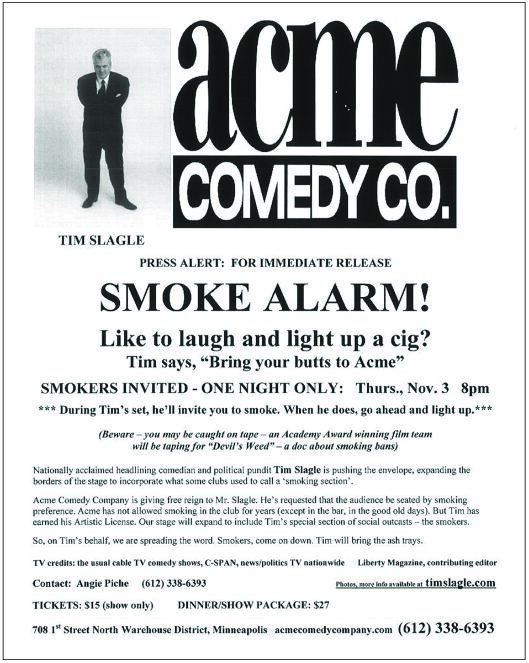
A flyer for Tim Slagle’s indoor smoking protest at Acme in the mid-2000s Courtesy Jen Bryce
”he remembers. “So I’d say, ‘Do you want to smoke?’ and bring some chairs onstage and call it the smoking section, and people would watch the rest of my show from the stage and smoke.” Much like the flag burning joke years earlier, word got out about his stunt. Only this time, his audience was far more
80 • CHAPTER 6
open to his antics. “People would wait for me to open up the smoking section onstage and ask to be the ones who got to come up. It was always big fun.”
The big fun got out of hand, however, and for the first— and only—time in their history together, Lee had to tell Slagle to kill the bit. “Louis comes up to me after a show one night and goes, ‘You’re still doing that smoking bit?’ And I said, ‘Yes, I am.’ He goes, ‘I heard someone pulled out a joint tonight and lit it onstage.’ I kind of laughed and said, ‘I did think that cigarette smelled a little funny,’ ” Slagle recalls, still giggling at the interaction years later. “So he just says, ‘I think that bit is hack now.’ Which was his way of telling me not to do it. That’s the only time he ever asked me not to do something onstage.”
From the early days of controversy (and maybe because of them), Slagle and Lee formed a friendship. And from that friendship emerged an exceedingly ambitious political offering (at least for a comedy bit): Mudslingers Ball. “Louis and I used to hang out after shows,” Slagle says. “We’d stay up all night drinking and come up with crazy ideas. I pitched him the idea of a political debate show, and he liked it.” The concept was simple: put two comedians onstage who had starkly differing political views and let them have at each other. Then, throw in some live audience questions and comments, to achieve the Jerry Springer car crash–style TV that was insanely popular at the time. Finally, follow a loose scorekeeping system, and declare a winner at the end of the show. The idea was innovative in a time when traditional stand-up was at its most stale.
“[If you were a comic] you were only supposed to have one opinion politically at that time,” Slagle recalls. “I’ve always been antiauthoritarian, and I felt like at that point the people on the left were actually embracing a lot of the ideas that [they] had typically been opposed to, because they worked in their favor.”
The stage was set for, fittingly, Fourth of July week 1997 at Acme. On the right, you had Slagle. His opponent on the
POLITICALLY INCORRECT • 81
left was a West Coast–based comic named James Inman. And playing the emcee and referee for the evening was Minnesota comedy legend Alex Cole. They had the players and the structure, but getting people to understand their vision was a different matter. “A lot of people showed up just expecting a comedy show,” Slagle says. “Again, this was before the internet, so it was hard to promote it and tell people what we were going to do.” A review in the Star Tribune by comedy writer Colin Covert didn’t do the show any favors, taking the political experiment to task after the very first night. “The idea of a comic debate is an intriguing idea, but Tuesday’s opening night fell far short of its potential,” Covert wrote. “There were moments of political insight, but they weren’t side-splitting. There were laughs, but they weren’t based on exposing grand ideological idiocies.”
To their credit, Slagle and Inman stayed unflinchingly committed to the format. Slagle commented on everything from the repercussions of Hong Kong being handed over to China to his belief that the government should be trimmed back to the few areas where it had a proven record of competence, like sewage removal. Inman held his ground as well, raging over the idea that McDonald’s restaurants could keep their restrooms off-limits to non-customers.
Initial reviewers may have been lukewarm on the concept, but the show found an audience, and Slagle brought the Ball back to Acme several times after that. It did so well, in fact, that in 2000, Slagle and Lee decided to kick things up a notch by filming the show with the intent to sell it to a broadcast network. But to translate the act to TV, the show needed to be bigger. That meant a more grandiose production, and more comedians to hurl jabs at one another. “Lewis Black was just about to pop,” says Slagle. “We knew everyone would come in to see him. The thing I liked about Lewis was that he appreciated that I would offer counter opinions to him. Even when he started doing more media interviews talking about political
82 • CHAPTER 6
comedy, he would refer the reporters to me if they wanted to hear the other side.”
Along with Black, Acme decided to bring in political satirist Will Durst to stack the left side of the political scales. Durst, a Wisconsin native, was already an Acme favorite by that time, and his role as the host of the PBS series Livelyhood amplified his star power. Meanwhile, conservative comic Jeff Jena would come in to join Slagle in fending off their big shot political opponents. It was a perfect mix of personalities and politics, all the ingredients for making great television. The pilot taping was scheduled for early March, with plans of turning it around for TV stations shortly thereafter. While they had the talent and the concept, Lee and the rest of the team quickly realized they needed some additional help on the production side of things. Once again, Lee looked to his friends.
Rich Miller agreed to come in as a partner on the project, and former manager Jennifer Bryce was willing to serve as a producer. But according to Bryce, the project was the blind leading the blind. “They had the guys committed and a time to shoot it, but they didn’t have a showrunner to help pull it together,” she says. “Louis called me and asked me to do it. He offered me 10 percent in the project, but didn’t want me telling Rich and Tim that he had promised me a slice.” Bryce sprang into action the week of the event, setting up production, lighting, and talent management, all while butting heads with her newfound partners. “The show was Tim’s idea, but he felt intimidated by the people who had agreed to do it [Black and Durst],” she says. “So I literally spent the week running around pulling everything together, and Louis hasn’t told anybody why I’m here. People are looking at me like, We didn’t know Jen was involved in this.”
Her responsibilities went beyond producing and show running. “Lewis Black came up to me the day of the show and said, ‘I hope you found a good makeup artist.’ I told him that we had a shoestring budget, so he would have to do his own.
POLITICALLY INCORRECT • 83
He told me that he wasn’t going out in front of a camera without a decent makeup artist, so I had like two hours to track someone down. Luckily, my friend Beatrice who ran Fashion Week was around, so she agreed to come in and do it, so Lewis was happy. But when other people saw me bringing in friends and telling people what to do, it really annoyed them.”
Hiccups and production headaches aside, the taping was a success. Now they just needed to find someone to put it on the air. “KSTP [the local ABC affiliate in Minneapolis] picked up the show the next month,” Slagle recalls. “They put us on Saturday night, and we actually came in second locally, behind SNL but ahead of MADtv.” The wheels were spinning, and it looked like big things were in store for the show. Slagle and Lee envisioned a broader focus for the Ball moving forward, with teams that brought female and minority perspectives to the table, along with new topics of debate. “You could have fat guys who loved sandwiches against girls who eat only salads,” laughs Slagle. “I wanted to keep it political, but the point was that it could be flexible depending on where we went.” The following month, it was announced that Mudslingers Ball would visit Slagle’s hometown of Chicago as part of the Chicago Comedy Festival, with the same foursome doing battle. The Ball was going on the road.
Back at home, the show had outperformed network expectations, and KSTP was interested in having more episodes produced. “They didn’t hit our number,” Slagle says, explaining how the station failed to meet the crew’s asking price for more of the televised mud battle. “In retrospect, we should have taken advantage of that, found some investors, and tried to make something of it.” Once it became clear they would part ways with KSTP, Bryce asked if she could take a stab at shopping the show somewhere else. “We created this really brilliant show,” she remembers. “And Louis was the spider at the center of it. So after it got some attention locally, Rich Miller said he was going to try and sell it somewhere else. When he couldn’t,
84 • CHAPTER 6
I asked if I could take it, and I was told, ‘No, that’s Rich’s territory.’ At that point I was mad at Louis, everyone was mad at me, and it just sort of drifted away.”
To their credit, Miller, Slagle, and Lee did take it to Hollywood and screened the show for a handful of network executives. “They told us that it was interesting, but that they didn’t want to do a Minnesota show,” recalls Slagle. “But wouldn’t you know it? Six months later there were a couple of shows on their networks that were nearly identical.” One of the original concept’s stars wound up hosting one of these new shows. “He might admit it, I don’t know,” Slagle says reluctantly. “But basically Lewis Black took our show and it became Root of All Evil.”
Root of All Evil was on the air for less than a year in 2008, and featured Black playing moderator while two comics debated a variety of topics. Andy Kindler and Paul F. Tompkins clashed over the NRA and PETA; Greg Giraldo and Kathleen Madigan sparred on strip clubs and sororities; Andy Daly and Patton Oswalt debated Las Vegas and the human body. The show received mixed reviews from critics but was a hit with viewers. While Black has never gone on record to say that he based the show on Mudslingers Ball, the similarities are certainly evident. In fact, one of the original mudslingers, James Inman, still boasts on his website, “co-creator of Mudslingers Ball, which later became Lewis Black’s Root of All Evil.”
Though the show never resurfaced locally, Slagle and Lee’s bond has continued to grow stronger, with Slagle still coming back to Acme every year. “Louis has always told me, ‘I’ve been right about every comic who I’ve ever said was going to make it big—except for you,’ ” Slagle laughs. “Maybe that’s why he keeps letting me try things and get away with so much. He doesn’t want to be wrong.” No matter Slagle’s career fortunes, Acme will always be a place that is willing to take risks and provide a stage for comics to share their beliefs, even if it ends with two hundred people leaving the club before the show
POLITICALLY INCORRECT • 85
is over. “I love coming to Acme because I can push it there,” Slagle says. “Before my week there every year I go through my old notebooks and find the stuff I can’t do anywhere else anymore, because I know there’s an audience for it at Acme.”
Lee is guarded when it comes to his relationships with comics, and was even more so back in his early days. But his connection with the local comics was always much deeper than business, and that depth allowed him to quietly beam with pride over their success. Unfortunately, Lee would soon learn that that connection could also result in a great deal of pain, frustration, and sadness.